
Sizing a solar water pump is a five-number problem. You need the daily water volume (m³/day), the total dynamic head the pump must overcome (m), the design flow rate that follows from dividing volume by usable sun hours (m³/h), the pump model whose performance curve covers that duty point, and the PV array that drives it — conventionally around 1.3–1.5× the pump's rated power. Get head and flow right and everything else falls into place; get them wrong and no amount of extra panels will rescue the system.
This guide works through each step in order, with the arithmetic shown, so you can size a system on paper before asking any supplier for a quotation. The method applies to any manufacturer's catalogue; example figures come from published Aquasolar specifications simply because those are the numbers we can verify.
The five numbers, in order
Solar pump sizing has a strict dependency chain, and skipping ahead is the single most common source of failed systems:
- Daily volume (m³/day) — what the crop, herd or community actually consumes on a peak day.
- Total dynamic head (m) — the lift the pump must produce, including friction and outlet pressure.
- Design flow (m³/h) — daily volume divided by the hours of usable sunshine.
- Pump model — the unit whose curve delivers the design flow at the total head.
- PV array (Wp) — sized above the pump's rated power so the duty point is reached in real conditions.
Note that panel wattage comes last: a buyer who starts by asking "how many panels do I need?" has begun at the wrong end of the chain.
Step 1 — Work out the daily water requirement
Design for the peak demand month, not the annual average. A pump that satisfies the mean will fail exactly when the crop or the herd needs water most.
Irrigation
The useful conversion is that 1 mm of water applied over 1 hectare equals 10 m³. Peak-season crop water use commonly falls in the range of 4–8 mm/day depending on climate, crop and growth stage — hot, dry, windy conditions and full canopy push it towards the upper end.
Then divide by the efficiency of the application method, because not all pumped water reaches the root zone:
| Application method | Typical field efficiency | Effect on pumped volume |
|---|---|---|
| Drip / micro-irrigation | High (roughly 0.85–0.95) | Lowest pumped volume for the same crop need |
| Sprinkler | Moderate (roughly 0.70–0.85) | Wind and evaporation losses add up |
| Furrow / basin / flood | Low (roughly 0.50–0.60) | Can nearly double the pump and array required |
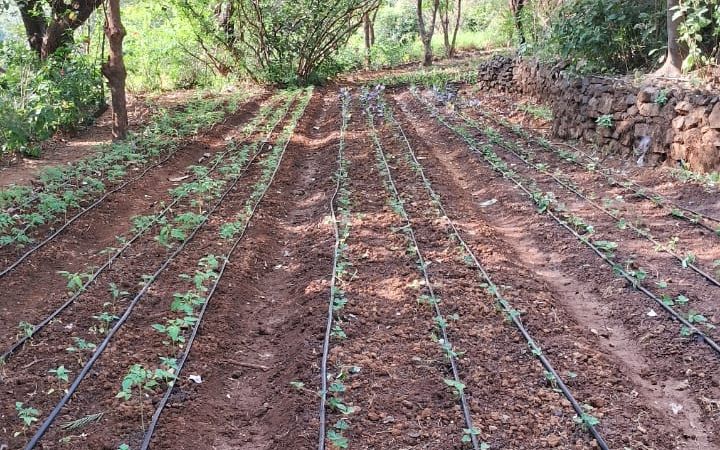
So one hectare of drip-irrigated vegetables at a peak use of 5 mm/day needs 1 × 5 × 10 = 50 m³/day at the plant, or about 55 m³/day at the pump once drip efficiency is allowed for.
Livestock
Livestock demand is per-head and reasonably predictable. Common design allowances are in the order of 30–70 litres/head/day for cattle and 5–10 litres/head/day for sheep and goats, rising in hot weather and for lactating animals. Add an allowance for trough evaporation and spillage. A 200-head cattle operation at 50 L/head/day therefore needs roughly 10 m³/day.
Domestic and community supply
Basic domestic consumption is often designed at 20–50 litres/person/day from standpipes, and commonly 60–100+ litres/person/day where houses have internal plumbing. Add a separate allowance for schools and clinics, and a growth margin — a borehole and pump are expected to serve for a decade or more.
Step 2 — Calculate total dynamic head (TDH)
Total dynamic head is the total resistance the pump works against, in metres of water. It has three parts, and buyers routinely forget two of them.
Static lift
Measure from the dynamic (pumping) water level to the point of discharge — not from the borehole depth and not from the standing water level. When a pump runs, the water level in the borehole falls; that drop is called drawdown, and the level it settles at is the dynamic level. A borehole drilled to 90 m with a standing level of 30 m and 10 m of drawdown at your design flow has a static lift of 40 m to ground level, plus the height of the tank inlet above ground.
Drawdown comes from the borehole's pumping test. If no test data exists, obtain it first — it drives both the head calculation and the maximum flow the well can sustain.
Friction losses in the pipework
Water flowing through pipe, bends and valves loses energy. As a rule of thumb, correctly sized rising main and delivery pipe adds on the order of 5–10% of the static lift. That figure is only true if the pipe is properly sized: friction rises very steeply with velocity (roughly with its square), so one nominal size too small can turn a 5% loss into a 20–30% loss and quietly destroy the system's output.
A common design target is to keep water velocity in the rising main around 1–2 m/s. Long horizontal runs to a distant tank must be included — a 400 m surface run can easily contribute more head than the vertical lift.
Pressure required at the outlet
If the pump feeds an open tank, the required outlet pressure is zero and the tank inlet height is simply part of the static lift. If the pump feeds an irrigation system directly, you must add the operating pressure of that system, converted to metres: 1 bar is about 10.2 m of head.
- Drip and micro-irrigation typically operate around 0.7–1.5 bar → add roughly 7–15 m.
- Sprinkler systems typically need 2–4 bar → add roughly 20–40 m.
This is why pumping into an elevated tank and then distributing by gravity is usually the cheaper architecture: it removes the pressure requirement from the pump duty entirely.
TDH worksheet
| Component | Example value | Notes |
|---|---|---|
| Dynamic water level below ground | 40 m | From the pumping test at design flow, not the standing level |
| Tank inlet above ground | 5 m | Elevated tank or hillside storage |
| Static lift subtotal | 45 m | Sum of the two above |
| Pipe friction | 4–5 m | Roughly 10% for a correctly sized rising main |
| Outlet pressure | 0 m | Discharging into an open tank |
| Total dynamic head | ≈ 50 m | The figure to select the pump against |
Step 3 — Convert volume into a design flow rate
A solar pump only produces its rated output around the middle of the day, so the daily volume has to be delivered within the usable solar window:
Design flow (m³/h) = daily volume (m³) ÷ usable peak sun hours
"Peak sun hours" is the equivalent number of hours at full irradiance, and in most sunny regions it falls between about 4 and 7 depending on latitude and season. Roughly 6 hours is a widely used planning figure for good sites; use 4–5 for cloudier climates or winter-critical demand. The pump does still turn outside that window at reduced output — the MPPT controller keeps it running on partial sun — but designing to the equivalent-hours figure builds in the right margin.
| Daily volume | Flow at 4 sun hours | Flow at 5 sun hours | Flow at 6 sun hours |
|---|---|---|---|
| 10 m³/day | 2.5 m³/h | 2.0 m³/h | 1.7 m³/h |
| 25 m³/day | 6.3 m³/h | 5.0 m³/h | 4.2 m³/h |
| 55 m³/day | 13.8 m³/h | 11.0 m³/h | 9.2 m³/h |
| 100 m³/day | 25.0 m³/h | 20.0 m³/h | 16.7 m³/h |
Then check the design flow against the well. If the borehole's sustainable yield is 5 m³/h and your design flow is 9 m³/h, the pump will draw the water level down to its intake and trip on dry-run protection every day. The fix is not a bigger pump: it is either a lower flow pumped over more hours, a larger storage tank, or a second water source.
Step 4 — Match the duty point to a pump model
Now you have a duty point: a required flow at a required head. Two rules matter when reading any catalogue:
A pump's headline head and flow figures are not simultaneous. A model quoted at 260 m of head delivers its lowest flow there, and a model quoted at 40 m³/h reaches that flow at low head. Every model is a curve, and you are looking for a curve that passes through — or comfortably above — your duty point.
Select with margin, then confirm against the curve. A common practice is to shortlist models whose rated head exceeds the calculated TDH by around 20%, because water levels fall in dry seasons, pipes scale up internally over the years and field conditions rarely match the test bench. Our own sizing calculator applies a 1.2× margin for exactly this reason, and any shortlist should then be confirmed against the full performance curve before an order is placed.
Worked shortlists for three of the duty points above, using published catalogue models:
| Requirement | Duty point | Example model | Rated specification |
|---|---|---|---|
| 200-head cattle, 130 m borehole | ≈ 2 m³/h at 130 m | 3PWSS2.0-130-96-750 | 750 W, 130 m, 2.0 m³/h, 96 V — 3″–4″ DC screw series |
| 1 ha drip vegetables | ≈ 9 m³/h at 50 m | 4PSC9.0-60-144-1100 | 1,100 W, 60 m, 9.0 m³/h, 144 V — 4″ DC plastic-impeller series |
| Village scheme, deep borehole | ≈ 6 m³/h at 190 m | 4PPSS6.0-190-280-2200 | 2,200 W, 190 m, 6.0 m³/h, 280 V — 4″–6″ DC stainless series |
Two further criteria sit alongside head and flow. Borehole diameter — a 4″ pump body will not enter a 3″ casing — is covered in our deep-well pump selection guide. Water quality decides pump type: sandy or silty water calls for a sand-tolerant screw (progressive-cavity) pump, brackish or coastal water for upgraded stainless wetted parts. Published sand tolerances differ sharply — the screw series is rated to ≤0.25% sand content against ≤0.05% (≤500 g/m³) for the impeller series — so check it rather than assume it.
Step 5 — Size the PV array
The array must be larger than the pump's rated power, for reasons that are entirely physical rather than commercial:
- Module output is rated at 25 °C cell temperature; in the field, panels in full sun run far hotter and produce measurably less than their nameplate.
- Dust, soiling, wiring losses, non-ideal tilt and orientation all subtract further.
- An oversized array reaches the pump's starting threshold earlier in the morning and holds output later in the afternoon, which lengthens the pumping day — often the difference between meeting the daily volume and missing it.
The widely used rule is 1.3–1.5× the pump's rated power. Checked against the recommended arrays published in the Aquasolar catalogue, the real ratios sit between about 1.2× and 1.65×, clustering in that 1.3–1.5× band:
| Pump rating | Recommended array | Ratio |
|---|---|---|
| 300 W | 400 Wp (1 × 400 Wp) | 1.33× |
| 600 W | 900 Wp (3 × 300 Wp) | 1.5× |
| 1,100 W | 1,800 Wp (6 × 300 Wp) | 1.64× |
| 2,200 W | 3,000 Wp (10 × 300 Wp) | 1.36× |
| 3,000 W | 3,900 Wp (13 × 300 Wp) | 1.3× |
Push towards the upper end where a site is winter-critical, at high latitude, hazy or dusty. Our shorter companion note on sizing a solar array for your pump covers the ratio question on its own.
Array configuration matters as much as total wattage. The string must deliver a voltage inside the controller's MPPT tracking window: too few modules in series and the pump never reaches speed; too many and open-circuit voltage can exceed the controller's limit. Catalogue system voltages run from 12 V up to 385 V, and each datasheet states both the nominal system voltage and the recommended module string — follow it rather than improvising with whatever panels are in stock.
Step 6 — MPPT and cable: the details that decide daily output
What MPPT actually does. A PV module's maximum power occurs at one specific voltage, and that voltage moves continuously with irradiance and cell temperature. A maximum power point tracking controller hunts for that point many times a second and converts it to what the motor needs. Without MPPT, the pump operates wherever the motor's impedance happens to intersect the module curve — usually well off the peak — and the array is effectively derated. Controllers in this class quote tracking efficiencies above 99%, which is why the sizing rules above assume MPPT rather than a direct connection.
Cable sizing. Voltage lost in the cable is head you never get, and undersized cable on a long borehole drop is a classic cause of a pump that "underperforms" while every component tests good. The published recommendation across the Aquasolar range is 2.5–4 mm² copper by model, sized for approximately a 50 m run, stepping up one size per additional 50 m of drop.
Five sizing mistakes that cost water
- Sizing head from borehole depth instead of the dynamic water level — this overstates head by tens of metres and buys a needlessly expensive pump.
- Ignoring drawdown and well yield — the most frequent cause of daily dry-run trips.
- Matching array watts to pump watts 1:1 — the pump then only reaches rated output in perfect conditions, briefly, around noon.
- Forgetting outlet pressure — feeding a sprinkler system directly can add 20–40 m of head that never appeared in the calculation.
- Under-sizing pipe to save money — friction scales roughly with the square of velocity, so the saving is repaid in lost water every day of the system's life.
Worked example, end to end
A farmer irrigates 1 hectare of drip-fed vegetables. Peak crop use is 5 mm/day; the borehole's standing level is 30 m with 10 m of drawdown at the intended flow; water goes to a tank whose inlet is 5 m above ground; the site averages about 6 peak sun hours in the growing season.
- Daily volume: 1 ha × 5 mm × 10 = 50 m³/day at the plants; ÷ 0.9 drip efficiency ≈ 55 m³/day.
- TDH: 40 m dynamic level + 5 m tank inlet = 45 m static; +10% friction ≈ 50 m. Outlet pressure is zero because the tank is open, and the drip system's own 1 bar is supplied by gravity from the tank.
- Design flow: 55 ÷ 6 ≈ 9.2 m³/h.
- Well check: the pumping test must confirm a sustainable yield of at least ~9 m³/h at 10 m drawdown. If it does not, reduce flow and enlarge the tank.
- Pump: a 4″ submersible rated around 9 m³/h at up to 60 m head — e.g. 4PSC9.0-60-144-1100, 1,100 W at 144 V — clears the 50 m duty with margin.
- Array: 1,100 W pump → 1,800 Wp (6 × 300 Wp), a 1.64× ratio, wired to the string configuration on the datasheet.
- Storage: a tank holding 1–2 days of demand (55–110 m³) so that a cloudy day does not become a lost irrigation day.
Every number in that chain is checkable, and every one changes the answer — which is why a credible supplier asks for head, daily volume, water source and location before quoting a model, and why a quotation offered without them is guesswork.
Next step
Run your figures through the free solar pump sizing calculator for a shortlist from the full catalogue, browse the complete pump range, or send us your total head, daily volume and water source for a sized proposal with the performance curve.
FAQ
How do I calculate total dynamic head for a solar pump?
Total dynamic head is the dynamic (pumping) water level plus the height of the discharge point above ground, plus pipe friction losses, plus any pressure required at the outlet. Measure from the water level while pumping, not from the drilled depth of the borehole. Friction is commonly 5–10% of the static lift for correctly sized pipe, and outlet pressure converts at about 10.2 m of head per bar, so a directly fed sprinkler system can add 20–40 m.
What size solar array does a solar water pump need?
The array is normally sized to roughly 1.3–1.5 times the pump's rated power, so a 1,000 W pump takes about 1,300–1,500 Wp of modules. The oversizing compensates for cell-temperature losses, soiling and imperfect orientation, and it lets the pump start earlier and run later each day. Array voltage must also fall inside the controller's MPPT window, so follow the module string configuration on the pump's datasheet rather than only matching total wattage.
How many hours a day does a solar pump run?
A solar pump produces its rated output for the equivalent of roughly 4–7 peak sun hours a day depending on latitude, season and weather, with about 6 hours a common planning figure for sunny regions. It also turns at reduced output either side of that window, because the MPPT controller keeps it running on partial sunlight. Size the flow rate on the equivalent peak-hour figure and store water in a tank to cover the rest of the day.
Do I need batteries for a solar water pump?
No. The standard and lower-cost approach is to store water rather than electricity: the pump runs directly from the panels through an MPPT controller during daylight and fills a tank that supplies demand around the clock. A tank has no cells to replace. Where water is genuinely needed at night and storage is impractical, an AC/DC hybrid pump that can switch to grid or generator power is usually a better answer than a battery bank.
What happens if I oversize the pump instead of sizing it properly?
An oversized pump draws the borehole down faster than the aquifer recharges, so it trips repeatedly on dry-run protection, and it needs a larger and more expensive array to reach its duty point at all. It also runs further from its best-efficiency point, which wastes energy and increases wear. Sizing the flow to the well's sustainable yield and pumping for longer into storage delivers more water per day than an oversized pump that keeps stopping.