
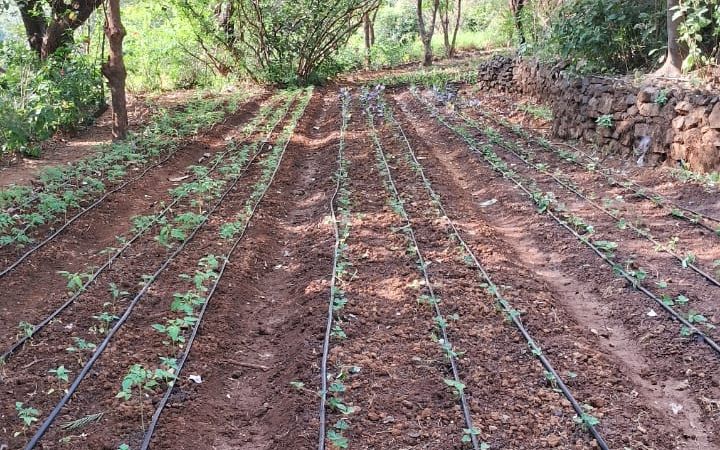
A solar irrigation system is designed in a specific order: water source, then storage, then distribution method, then pump, then array. The central design decision is that solar irrigation stores water, not electricity — a tank sized for one to three days of demand replaces a battery bank at a fraction of the cost and with nothing to replace. The second is that pumping into an elevated tank and irrigating by gravity almost always beats pumping directly into a pressurised line, because it removes the irrigation system's operating pressure from the pump's duty and decouples watering times from sunshine.
This guide covers the layout and architecture decisions, not the arithmetic of pump selection — for that, see the step-by-step sizing guide. It is written for growers, agricultural dealers and project developers specifying systems from smallholder plots up to tens of hectares.
Start with the water source, not the field
The source sets a ceiling on everything downstream, and it is the one part of the system you cannot redesign later.
Boreholes and deep wells. The critical figure is the sustainable yield in m³/h from a pumping test, along with the static water level and drawdown at that flow. A borehole yielding 4 m³/h cannot irrigate a field that needs 9 m³/h of gross application, regardless of what pump you fit. The design response is a larger storage tank filled over a longer day, not a bigger pump — a pump that outruns the aquifer simply trips on dry-run protection.
Open wells, canals, rivers and ponds. Surface water usually offers ample volume but comes with three complications: seasonal level change, debris and sediment, and legal abstraction limits. Screen the intake, and design the suction arrangement for the lowest seasonal level. Surface pumps handle this well where the lift is modest — flows to 80 m³/h at 14–40 m of head in the DC surface range — while a high-flow submersible in an open well or sump is the alternative where the water is below suction reach.
Water quality drives pump materials and filtration together. Sediment that erodes an impeller will also block drip emitters, so the filtration you install for the irrigation system and the pump type you choose for the water are the same decision. Sandy or silty water points to a sand-tolerant screw pump — rated to ≤0.25% sand content, against ≤0.05% for impeller pumps — plus sand separation ahead of any drip system.
Architecture: tank-and-gravity versus direct pressurised
Almost every solar irrigation system is one of two architectures, and the choice shapes cost, reliability and pump size.
| Pump → tank → gravity distribution | Pump → directly into irrigation line | |
|---|---|---|
| Pump duty | Lift to tank inlet only; no system pressure | Lift plus full system operating pressure |
| Irrigation timing | Any time, day or night | Only while the sun is on the array |
| Flow stability | Constant gravity pressure | Varies with irradiance through the day |
| Buffer against cloud | Tank volume covers cloudy days | Watering stops with the sun |
| Extra cost | Tank, stand or elevated site | None |
| Best for | Most systems, especially drip | Sprinkler on flat ground with no elevation available, short runs |
The tank architecture wins for three reasons that compound. It shrinks the pump duty — a drip system needing about 1 bar is 10 m of head the pump no longer has to produce, and a sprinkler system at 2–4 bar is 20–40 m saved. It stabilises emitter flow, which matters because drip emitters are designed for a narrow pressure band and deliver unevenly outside it. And it decouples irrigation from irradiance, letting you water early morning or evening when evaporation losses are lowest.
Height is what converts a tank into pressure: roughly 1 metre of elevation gives about 0.1 bar. A drip system wanting 0.7–1.0 bar therefore needs its tank outlet some 7–10 m above the field, whether on a stand, a hill or a bund. If no elevation is available and the crop needs pressure, a booster pump fed from the tank is usually cheaper and more reliable than sizing the main pump to pressurise the field directly.
Why not batteries?
For irrigation, batteries add capital cost, a replacement cycle and a maintenance burden to solve a problem that water storage already solves. Crops do not care whether water arrives at noon or at dusk, so long as it arrives; a tank is an energy store measured in cubic metres. Batteries earn their place only where the load genuinely cannot be time-shifted — and irrigation, by its nature, can be.
A partial exception is the AC/DC hybrid pump, which is not a battery system but can draw on grid or generator power when solar is short. On farms that also supply a household or dairy from the same borehole, that fallback is often worth more than extra storage.
Sizing storage
Storage volume is a reliability decision:
- One day of peak demand — the practical minimum, letting you irrigate on your schedule rather than the sun's.
- Two to three days — the common design range, covering a cloudy spell without losing an irrigation cycle at a critical growth stage.
- More than three days — rarely economic; the tank cost outruns the benefit, and stored water quality can suffer.
Size on peak-month demand, not the annual average. Cover the tank to control algae and evaporation, fit an overflow, and fit a level control that stops the pump when the tank is full. Many solar controllers accept a float or probe input for exactly this, which prevents both overflow waste and needless pump running.
Matching the distribution method to the system
The irrigation method changes the volume you must pump, the pressure you must provide and the filtration you must install.
| Drip / micro-irrigation | Sprinkler | Furrow / basin / flood | |
|---|---|---|---|
| Typical operating pressure | 0.7–1.5 bar (≈ 7–15 m head) | 2–4 bar (≈ 20–40 m head) | Effectively none |
| Typical field efficiency | High, roughly 0.85–0.95 | Moderate, roughly 0.70–0.85 | Low, roughly 0.50–0.60 |
| Filtration need | High — emitters clog easily | Moderate — nozzle screens | Minimal |
| Fit with solar | Excellent: low pressure, low flow, long hours | Workable, but pressure raises pump size | Wasteful of pumped water |
| Best suited to | Row crops, orchards, greenhouses, vegetables | Pasture, cereals, uneven canopies | Where water is abundant and cheap to lift |
Drip is the natural partner for solar pumping. It needs the least water and the least pressure, and it tolerates the steady, moderate flow a solar system delivers best. The catch is filtration: drip emitters block, and a solar system running unattended all day will happily irrigate a blocked line. Budget for the right filter class for your water, and check it on a schedule.
Sprinkler works, but you pay for the pressure. Adding 2–4 bar to the duty raises head by 20–40 m, which raises the pump rating, which raises the array. Where sprinkler is required, gravity from an elevated tank supplies part of the pressure and a small booster the rest — usually cheaper than a main pump sized for the whole duty.
Flood and furrow irrigation is the poorest match, because low efficiency multiplies the volume you must lift and therefore the size of the whole system. Where flood irrigation is retained for agronomic reasons, expect the pump and array to be roughly twice what drip would need for the same crop.
Field layout and hydraulics
Layout decisions quietly determine how much of the pump's energy reaches the crop.
Keep the pump close to the source and the tank close to the field. Long horizontal pipe runs cost head. A 400 m delivery line can easily contribute more friction head than the vertical lift, so where the tank sits matters as much as how high it sits.
Size pipe generously. Friction rises roughly with the square of velocity, so one nominal size too small can turn a 5% loss into a 20–30% loss. A common design target is 1–2 m/s in the main line. Pipe is a one-off cost; friction is a daily loss for the system's whole life.
Split the field into zones (blocks). Irrigating the whole area at once demands the peak flow the pump can deliver; irrigating in sequence lets a smaller pump and pipe network serve the same area over the day. Zoning is the standard way to reconcile a modest borehole yield with a large field, and it also improves emitter uniformity by keeping each block's flow within its design band.
Respect terrain. On sloping ground, downhill laterals gain pressure and uphill laterals lose it. Run laterals along the contour where possible, and use pressure-compensating emitters where slope exceeds what the emitter's band can absorb.
Place the array where it will stay clean and unshaded. Face it towards the equator (south in the northern hemisphere, north in the southern), tilt it roughly at the site latitude — commonly a 10–30° range in low and mid latitudes — and keep it clear of trees, buildings and the tank itself. Even partial shading on one module disproportionately reduces string output. Leave space to walk round it for cleaning, and mount it high enough and securely enough to survive livestock and wind.
Designing for seasonal variation
A solar irrigation system faces two seasonal cycles that often move in opposite directions, and this is where paper designs fail in practice.
Solar resource varies. Usable peak sun hours are highest in summer and lowest in winter, and the swing grows with latitude. If your critical irrigation demand falls in a low-sun month, size the system for that month rather than for the annual average — otherwise the system is adequate for most of the year and short exactly when it matters.
The water table moves. In many regions the static level falls through the dry season, which increases total head at the very time demand peaks and solar output may already be limited by haze or dust. Two design responses follow:
- Size head against the worst-case dry-season water level, not the level measured on the day of the survey.
- Set the pump deep enough to remain submerged at that level, within its maximum immersion rating — 150 m for the deep-well series in this range, but only 20 m for high-flow open-well models.
Crop demand varies with growth stage. Peak crop water use commonly falls in the 4–8 mm/day range depending on climate and stage, and the peak is short. Designing for the peak week and accepting spare capacity for the rest of the season is normal; the alternative is a system that under-irrigates during flowering or fruit set, which is when yield is decided.
Plan for the shoulder seasons deliberately. In low-sun months the same array delivers less, so the same pump fills the tank more slowly. If winter cropping is part of the plan, either accept a longer fill time with more storage, or oversize the array towards the upper end of the usual 1.3–1.5× ratio.
A worked layout
A 3-hectare mixed vegetable farm, drip-irrigated, on a borehole yielding 6 m³/h:
- Demand: peak use 5 mm/day over 3 ha = 150 m³/day at the plants; ÷ 0.9 drip efficiency ≈ 167 m³/day gross.
- Source check: 6 m³/h × 6 usable solar hours = 36 m³/day. The borehole cannot meet the demand — a hard constraint discovered on paper rather than after purchase.
- Design response: irrigate 1 hectare per day on a three-day rotation (≈ 56 m³/day), still above yield over a 6-hour window, so extend pumping across the whole solar day and buffer in storage; or develop a second source. Zoning plus storage is what makes the arithmetic work.
- Storage: ≈ 2 days of a single zone's demand, so roughly 110 m³, in a covered tank raised to give about 1 bar at the field.
- Distribution: three drip zones, valved, each sized so its flow matches what gravity from the tank can deliver evenly.
- Pump: selected for the flow the well can sustain at the borehole's total dynamic head — from the 4″ pump range for a typical 100 mm casing.
- Array: roughly 1.3–1.5× the pump's rated power, tilted near site latitude, sited clear of shade.
The instructive part of that example is that the field did not dictate the design — the borehole did. That is normal, and finding out at the design stage is the entire point of doing it on paper.
Next step
See the irrigation solutions overview for recommended pump series, size your duty point with the free pump sizing calculator, or send us your field area, crop, water source and water level for a system proposal.
FAQ
Should a solar irrigation system use a storage tank or batteries?
A storage tank, in almost every case. Crops do not need water at a fixed hour, so storing water is a cheaper and simpler way to time-shift than storing electricity, and a tank has no cells to replace. One to three days of peak demand is the usual design range. Batteries only make sense where the load truly cannot be shifted; where a farm also needs night-time supply, an AC/DC hybrid pump with grid or generator fallback is normally a better answer.
How high does the tank need to be for drip irrigation?
Roughly 1 metre of elevation produces about 0.1 bar, so a drip system needing 0.7–1.0 bar wants its tank outlet approximately 7–10 m above the field. That can come from a stand, a hill or a raised bund. If the site offers no elevation, a small booster pump fed from the tank is usually cheaper and more reliable than sizing the main pump to pressurise the field directly.
Can a solar pump run drip irrigation directly without a tank?
It can, but flow then varies with sunlight through the day, which pushes emitters outside their design pressure band and waters unevenly. You also lose the ability to irrigate early morning or evening when evaporation is lowest, and a cloudy spell stops irrigation entirely. Pumping into a tank and distributing by gravity gives constant pressure, removes the system pressure from the pump's duty, and buffers cloudy days.
How much land can a solar pump irrigate?
That depends on crop water use, irrigation method and available head far more than on the pump alone. As an order of magnitude, one hectare of drip-irrigated vegetables at a peak use of 5 mm/day needs roughly 50 m³/day at the plants, about 55 m³/day pumped. Flood irrigation of the same crop can need close to double. The binding constraint is usually the borehole's sustainable yield, so start from the pumping test rather than the field size.
How do I design for the dry season when the water table drops?
Size total head against the worst-case dry-season water level rather than the level on survey day, and set the pump deep enough to stay submerged at that level while remaining within its maximum immersion rating. Because dry-season demand peaks at the same time, add storage so the tank can be filled over a longer day at reduced flow. Where the critical irrigation month is also a low-sun month, size the array for that month, not the annual average.
Which irrigation method works best with a solar pump?
Drip and micro-irrigation, because they need the least water and the least pressure — typically 0.7–1.5 bar against 2–4 bar for sprinklers — which directly reduces the pump rating and array size. The trade-off is filtration: emitters clog, and an unattended solar system will keep irrigating a blocked line, so the filter class must suit the water and be checked on schedule. Sprinkler systems work, but the extra pressure is best supplied by tank elevation plus a small booster rather than by the main pump.